
- All
- Product Name
- Product Keyword
- Product Model
- Product Summary
- Product Description
- Multi Field Search
Views: 0 Author: Site Editor Publish Time: 2026-07-28 Origin: Site


Transporting live agricultural assets requires a precise balance between maximizing freight density and maintaining specimen viability, particularly for climate-sensitive species. Selecting the incorrect container size for transporting these plants leads to high mortality rates from root desiccation, transplant shock, and canopy damage, or results in exorbitant shipping costs due to wasted spatial volume. Finding the exact container specification ensures root integrity remains intact across long transit miles while optimizing pallet space. You must evaluate root system vulnerabilities, calculate freight density trade-offs, and select the exact container materials needed to mitigate transit damage and ensure high post-transplant survival rates. This guide provides a technical evaluation framework for determining the optimal container dimensions and nursery pot specifications required to safely transport and deploy commercial-scale orchards.
Freight Efficiency vs. Maturity: 3-gallon to 7-gallon containers offer the highest pallet density when sourcing guava trees wholesale for large-scale agricultural deployment, while 15-gallon+ containers are reserved for immediate-yield landscaping projects.
Root System Integrity: Psidium guajava possesses a shallow, aggressive root system; containers must provide sufficient depth to prevent root-binding during extended transit times.
Compliance and Logistics: Container size directly impacts soil volume, which dictates the strictness of phytosanitary inspections and the necessity of climate-controlled freight for sensitive tropical fruit trees.
Material Selection: Air-pruning pots and heavy-duty blow-molded containers significantly outperform standard thermoformed plastics in mitigating transit damage.
Establishing baseline metrics for transport success dictates the entire logistical approach. A successful shipment must achieve a survival rate exceeding 98%, maintain a low cost per landed tree, and minimize the days required for post-transplant stabilization. These metrics rely heavily on understanding the biological constraints of the plant during transit. You cannot manage what you do not measure, and in agricultural logistics, the primary measurements revolve around root health and spatial efficiency.
The root network of Guava Trees is notably shallow and fibrous. This structure makes the plant highly susceptible to rapid temperature fluctuations and moisture loss when removed from a stable nursery environment. Unlike taproot-dominant species that draw moisture from deep reserves, fibrous systems rely on the immediate surrounding soil volume to buffer against environmental stress. When you pull a plant from a controlled greenhouse and place it into a dry van, the clock starts ticking on root hair viability.
When comparing root sensitivity, tropical fruit trees with fibrous root systems generally suffer higher transplant shock. The fine root hairs responsible for nutrient and water uptake dry out rapidly if the container soil loses moisture. Furthermore, severe container restriction negatively impacts lateral root development. If roots begin circling within a confined pot, it compromises branch anchoring and long-term orchard yield once planted in the field. Field operators frequently observe that trees left in undersized containers for too long during transit require months of corrective pruning and root manipulation before they establish properly in native soil.
Root System Type | Primary Vulnerability in Transit | Moisture Buffer Requirement | Recovery Time Post-Transit |
|---|---|---|---|
Fibrous (e.g., Guava) | Rapid desiccation of fine root hairs | High (Requires saturated root ball) | 14 - 21 days |
Taproot (e.g., Mango) | Physical breakage of the main taproot | Medium | 30 - 45 days |
Adventitious | Stem rot from over-saturation | Low to Medium | 10 - 14 days |
Logistics managers face a constant inverse relationship between container volume and freight efficiency. Smaller containers reduce the soil mass, allowing more units to fit on a single pallet. This drastically lowers the shipping cost per unit. However, reducing the soil volume directly increases the risk of rapid desiccation, especially during Less-Than-Truckload transit where environmental controls may fluctuate. You must calculate the exact transit duration and match it to a container size that provides just enough buffer without wasting freight space.
Larger soil masses act as thermal and moisture buffers. They protect the delicate root hairs from drying out and insulate against sudden temperature drops. Balancing these factors requires a deep understanding of the specific route. For example, a shipment moving across arid regions requires a larger soil volume to counteract the low ambient humidity, even if it means sacrificing some pallet density. We consistently see higher success rates when operators prioritize root mass over maximum truckload capacity.
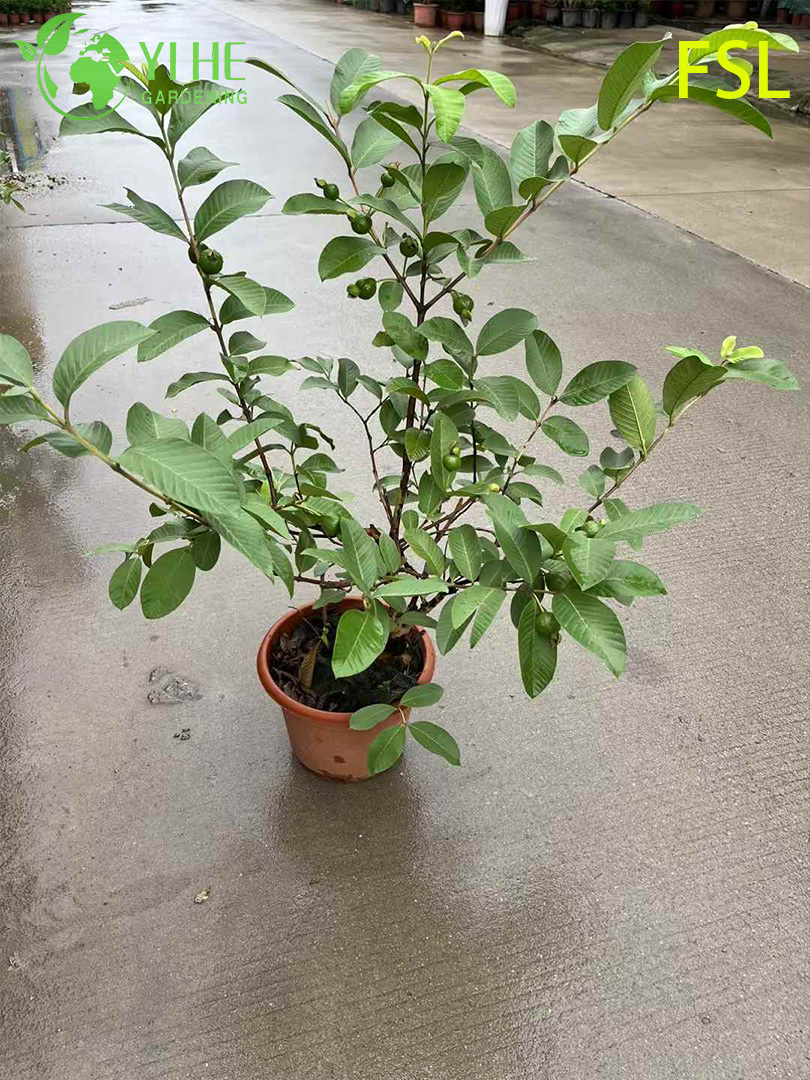
Selecting the right container size depends entirely on the end-use application and the available handling equipment at the receiving site. Different stages of maturity require distinct transport profiles. You must align the container specification with the operational capabilities of the planting crew.
Young Psidium guajava trees are frequently shipped in 1- to 3-gallon containers. These pots typically hold a minimal soil volume and support trees with a small caliper. This configuration is ideal for high-volume agricultural planting because the pots can be densely racked on standard 48-inch by 40-inch pallets. You can fit hundreds of these units onto a single pallet, making them highly efficient for large-scale orchard development.
Despite the freight advantages, these small containers have severe limitations. They are highly vulnerable to dehydration. Shipping plants in this size category requires expedited freight services and immediate field planting upon arrival to prevent catastrophic root loss. If a truck breaks down or a delivery is delayed by a weekend, the entire load can perish. Field crews must be prepped and ready with irrigation systems active the moment the truck bumps the dock.
Verify irrigation systems are fully operational at the planting site prior to dispatch.
Schedule delivery for early morning to avoid unloading during peak afternoon heat.
Stage the pallets in a shaded, wind-protected area immediately upon unloading.
Saturate the containers within two hours of arrival, regardless of perceived soil moisture.
The 5- to 7-gallon container represents the most common specification when sourcing guava trees wholesale. These units balance root mass with a manageable weight, typically ranging from 20 to 30 pounds per unit depending on soil moisture content. This is the sweet spot for commercial transport.
This size allows for single-stack or reinforced double-stack palletization, optimizing truck space while providing a crucial buffer against transit delays. The adequate moisture retention in the root ball ensures the trees arrive viable even if minor logistical hurdles extend the shipping timeline. Crews can handle these containers manually without heavy machinery, speeding up the staging and planting process.
For projects requiring immediate fruit production or instant landscape impact, 15- to 25-gallon containers are utilized. These large pots hold a massive soil volume supporting fruit-bearing age trees. The sheer weight and size of these units completely change the logistical requirements.
Transporting these units requires floor-loading or specialized oversized pallets, which significantly reduces the number of units per truckload and drives up freight costs. Additionally, handling these heavy containers necessitates mechanical equipment such as skid steers or lift gates at both the loading dock and the receiving site. You cannot manually unload a 53-foot trailer full of 25-gallon trees without risking injury to the crew and damage to the root balls.
Beyond simple volume, the physical dimensions and material construction of the container play a critical role in transport viability. You must look past the gallon rating and examine the actual geometry and structural integrity of the pot.
Calculating dimensional weight involves analyzing the container taper and the canopy spread of the trees. Nursery pots with a steep taper nest more efficiently, but they offer less soil volume at the base where roots accumulate. Strategies for nesting and securing tapered nursery pots are essential to prevent load shifting and physical root damage during transit. A load that shifts during hard braking will crush the outer rows of containers, leading to immediate inventory loss.
Container Size | Average Weight (lbs) | Pallet Density (Units/Pallet) | Moisture Buffer Capacity |
|---|---|---|---|
3-Gallon | 10 - 14 | 80 - 100 | Low (Requires expedited transit) |
7-Gallon | 22 - 30 | 35 - 50 | Medium (Standard transit buffer) |
15-Gallon | 60 - 80 | 10 - 15 | High (Excellent transit stability) |
25-Gallon | 100 - 130 | 4 - 6 | Maximum (Requires mechanical handling) |
The thermal mass of different soil volumes reacts differently during extreme weather. Container depth plays a vital role in preventing the lower root zone from drying out in non-refrigerated dry vans. Deeper pots keep the primary root mass insulated from the ambient air circulating around the topsoil layer. We recommend utilizing containers with a depth-to-width ratio that favors depth, as this naturally protects the taproot equivalents and deeper fibrous networks from surface evaporation.
Blow-molded plastics offer superior crush resistance when subjected to lateral freight forces compared to standard injection-molded or thermoformed plastics. They absorb impacts without cracking, keeping the root ball intact. When a forklift operator bumps a pallet, a thermoformed pot shatters, exposing the roots to air. A blow-molded pot simply flexes and returns to its original shape.
Air-pruning containers represent a significant upgrade. These specialized pots feature perforated walls that expose root tips to air, dehydrating them and forcing the plant to branch new roots internally. This prevents root circling and drastically improves post-transport establishment. While they cost more upfront, the reduction in transplant shock and the elimination of root-bound culling makes them highly effective for long-distance freight.
Moving agricultural material across borders or state lines introduces strict regulatory and environmental challenges. You must navigate a complex web of phytosanitary rules and climate control requirements to ensure the shipment arrives legally and safely.
Navigating state and international agricultural regulations regarding soil transport is mandatory. Larger container sizes hold more soil, which naturally triggers stricter nematode and pest inspections. Agricultural inspectors scrutinize large soil volumes heavily. If an inspector finds a single prohibited nematode in a 15-gallon pot, the entire shipment faces rejection or mandatory destruction.
In highly restricted zones, bare-root transport serves as an alternative to containerized shipping. While this eliminates soil-borne pest risks and reduces freight weight, it requires specialized packing protocols. You must use hydrogel dips and moisture-retaining wraps to prevent the fibrous roots from perishing. Bare-root shipping is a high-risk, high-reward strategy that demands flawless execution at the receiving end.
Verify all destination state agricultural restrictions regarding soil-borne pathogens prior to loading.
Ensure the nursery provides a clean bill of health and recent nematode certification.
Prepare a contingency plan for agricultural checkpoint delays, including emergency watering protocols.
Determining when refrigerated transport is necessary depends on container size, transit duration, and seasonal temperatures. Small containers moving during summer months almost always require climate control. The optimal temperature setpoint typically ranges from 50°F to 60°F. This range induces a temporary semi-dormancy in the plants, slowing transpiration and moisture loss without causing chilling injury. Dropping the temperature below 45°F risks permanent cellular damage to tropical species.
Protecting the canopy is just as important as protecting the roots. Techniques for sleeving and tying canopies ensure the branches match the footprint of the container, preventing mechanical damage when pallets are loaded tightly together. Furthermore, implementing strict pre-shipment inspection protocols helps identify and reject root-bound inventory before it ever reaches the loading dock. A root-bound tree will struggle to establish, regardless of how well it was transported.
Audit your receiving facility's material handling equipment to confirm capacity for unloading the specific container sizes ordered.
Calculate your target landed cost per tree by factoring in both the unit price and the specific freight density of the selected pots.
Request exact pallet configuration specifications and dimensional weights from wholesale nurseries before finalizing any large-scale orders.
Establish a strict 2-hour unloading and saturation protocol for your field crews to execute immediately upon truck arrival.
A: Under standard dry van conditions without climate control, 3-gallon containers typically support viability for 3 to 5 days. Expedited shipping or refrigerated transport is required for longer durations to prevent irreversible root desiccation.
A: A standard 48x40-inch pallet can typically accommodate 35 to 50 units of 7-gallon containers, depending on the canopy spread and whether the nursery utilizes a reinforced double-stacking method.
A: Climate-controlled freight is highly recommended for transits exceeding 48 hours, especially during extreme summer heat or winter freezes. Maintaining temperatures between 50°F and 60°F minimizes transpiration and prevents chilling injury.
A: Larger containers hold more soil, which increases the potential harbor area for soil-borne pests and nematodes. Consequently, shipments with massive soil volumes face more rigorous and time-consuming phytosanitary inspections at agricultural checkpoints.
A: Blow-molded pots are structurally thicker and offer high crush resistance against lateral freight forces. Thermoformed pots are thinner, more brittle, and prone to cracking under the heavy weight and vibration of transit.
A: Yes, bare-root shipping significantly reduces freight weight and bypasses many soil restrictions. However, because of their fibrous root systems, they require immediate replanting and specialized moisture-retaining packing gels to survive the journey.
A: Prevent desiccation by thoroughly saturating the root ball prior to loading, utilizing climate-controlled transport to lower the vapor pressure deficit, and tightly wrapping pallets to reduce airflow that strips moisture from the soil surface.


