
- All
- Product Name
- Product Keyword
- Product Model
- Product Summary
- Product Description
- Multi Field Search
Views: 0 Author: Site Editor Publish Time: 2026-08-21 Origin: Site


Improper palm tree spacing in high-traffic commercial developments presents severe financial and structural risks. When landscape architects prioritize immediate day-one visual density over long-term biological requirements, mature canopy overlap inevitably occurs. This crowding forces unnatural trunk curvature, shifts the center of gravity, and creates a high-risk environment for catastrophic trunk failure under wind load. Property developers constantly struggle to balance aesthetic impact with the strict spatial requirements necessary for healthy canopy growth, lateral root expansion, and the heavy machinery access required for routine maintenance.
A technical framework for calculating precise center-to-center spacing is the only reliable method to prevent premature specimen decline. By evaluating mature canopy dimensions, selecting appropriate species for the specific site footprint, and mitigating installation risks, project managers protect their landscape investments. Implementing strict spatial metrics ensures commercial landscape longevity, reduces ongoing maintenance liabilities, and maintains pedestrian safety across the property.
When landscape contractors install specimens too close together, the immediate result is a battle for sunlight. Palms are highly sensitive to light availability. If a canopy is shaded by an adjacent tree, the terminal bud alters its growth trajectory. This biological reaction, phototropism, forces the trunk to curve outward toward the strongest light source. You see this frequently in poorly planned median strips or dense resort pool areas where the trunk develops a permanent, sweeping lean.
This lean shifts the center of gravity away from the root plate. A straight trunk distributes the massive weight of the crown evenly straight down into the soil. A leaning trunk acts as a mechanical lever. It places constant, uneven tension on the lower trunk fibers. When high winds hit the site, that tension multiplies. The unnatural angle makes the tree highly susceptible to snapping mid-shaft or uprooting. Replacing a 40-foot specimen in a finished commercial plaza requires heavy cranes, lane closures, and massive labor costs. Proper initial spacing prevents this structural degradation entirely.
Unlike oak or maple trees, Palm Trees do not have woody roots that increase in girth. They rely on a fibrous root system. Thousands of small roots emerge from the root initiation zone at the base of the trunk. These roots spread laterally through the upper 24 to 36 inches of soil. They need a massive volume of uncompacted earth to anchor the tree and pull in moisture.
When you space trees too tightly, these lateral root zones collide. The roots compete aggressively for the same limited water and nutrients. You will quickly notice chronic yellowing in the lower fronds, a direct sign of nitrogen and magnesium deficiency. Furthermore, overlapping root masses drain localized soil moisture rapidly. Standard commercial irrigation systems often cannot keep up with the demand of crowded root zones during peak summer heat. The resulting drought stress weakens the trees, inviting secondary infections like Fusarium wilt or palmetto weevils. Giving each tree its own dedicated subterranean footprint is non-negotiable for long-term survival.
Commercial properties require ongoing canopy maintenance. Crews must remove dead fronds, cut heavy fruit stalks, and clear out seed pods. You cannot do this work from the ground on mature specimens. Contractors need access for 60-foot articulating boom lifts or bucket trucks. These machines require a minimum 15-foot clear footprint to deploy their stabilizing outriggers. If you space the trees too tightly, or place them too close to retaining walls, the machinery cannot set up safely.
When equipment access is blocked, contractors must climb the trees manually. This spikes your maintenance labor rates and increases job site liability. Additionally, tight spacing over pedestrian areas creates severe safety hazards. A mature date cluster can weigh 50 pounds. If it falls from 40 feet onto a crowded walkway, the liability is massive. Spacing calculations must account for these drop zones. You must keep the canopy footprint clear of sidewalks, outdoor dining patios, and parking spaces.
Landscape architects typically choose between grid and triangular layouts for large installations. The triangular spacing model is vastly superior for maximizing plant density while protecting individual tree health. In a triangular layout, you offset the rows. Each tree forms an equilateral triangle with its neighbors. This geometry allows you to space trunks at exact 9-meter (29.5-foot) intervals. You can yield up to 150 trees per hectare using this method.
Grid spacing aligns trunks in rigid squares. This creates wasted open space in the center of four adjacent trees, while simultaneously forcing the canopies to crowd along the linear rows. Triangular configurations eliminate that dead space. They create a continuous, visually striking upper canopy. More importantly, triangular spacing prevents irrigation overlap. You can place a dedicated bubbler or drip ring around each rootball without flooding the adjacent tree's root zone. This layout provides equal sunlight distribution and independent soil volumes for every specimen on the site.
The baseline rule for large palm trees for landscaping is 25-foot center-to-center spacing. This measurement ensures that mature fronds do not touch. Preserving the architectural silhouette of each tree is the primary goal of high-end commercial design. To calculate the exact distance for a mixed-species site, use a strict formula. Take the maximum mature canopy radius of the first tree, add it to the mature canopy radius of the second tree, and add two feet for wind sway clearance.
You must adjust these baseline metrics when planting near hardscapes. Trunks require a minimum 5 to 7-foot setback from concrete curbs, building foundations, and asphalt parking lots. As the tree matures, the trunk caliper expands. If planted too close, the expanding trunk and lateral roots will heave the concrete, causing trip hazards and expensive hardscape repairs. Underground utility lines require even stricter setbacks. You cannot allow fibrous root masses to engulf water mains or electrical conduits.
Massive species like the True Date Palm (Phoenix dactylifera) and the Canary Island Date Palm (Phoenix canariensis) dominate commercial plazas. They demand strict 25 to 30-foot spacing. A mature Canary Island Date Palm canopy easily exceeds 25 feet in diameter. If you crowd these massive trees, you destroy their symmetrical crowns. The fronds will bend and break against each other.
The sheer weight of these trees dictates their spatial footprint. A single mature frond weighs over 20 pounds. The crown holds hundreds of them. This immense top weight requires a massive, undisturbed root plate to prevent the tree from uprooting during a storm. Encroaching on their required 30-foot spacing guarantees structural failure. Furthermore, the dense shade cast by crowded date palms prevents any understory turf or shrubs from growing. You must leave enough space between the canopies to allow sunlight to reach the ground-level landscape.
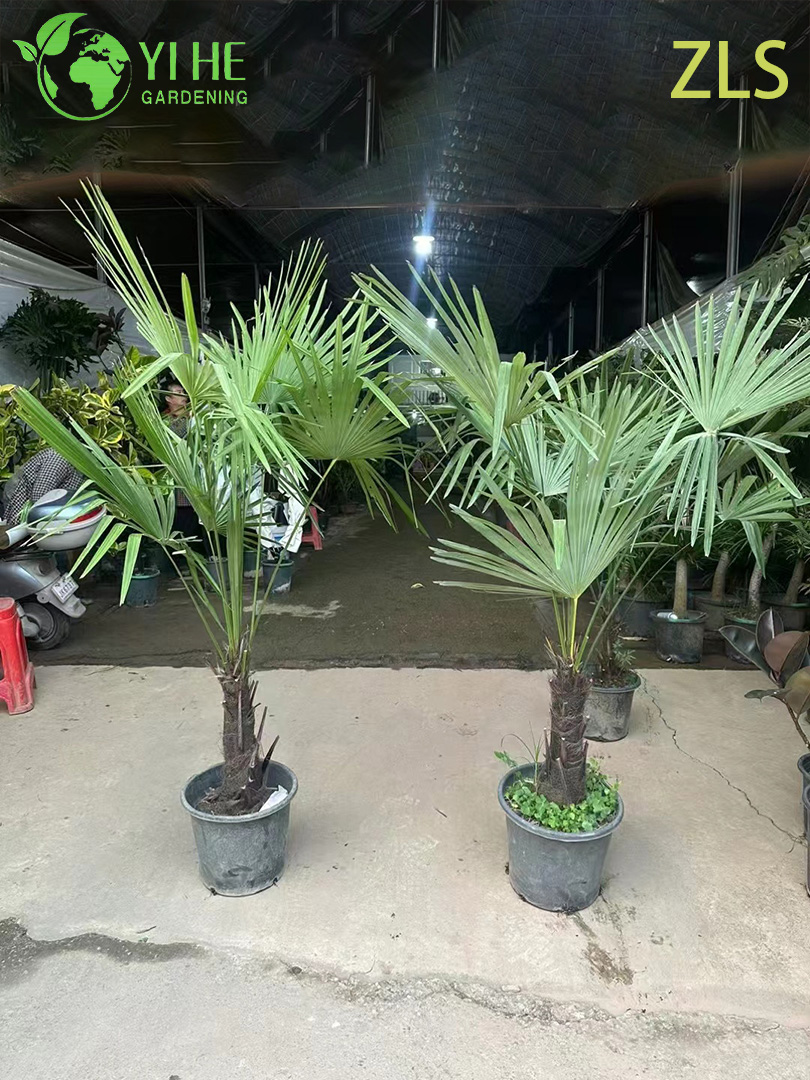
Tight architectural niches and cold-hardy commercial zones require compact species. The windmill palm tree (Trachycarpus fortunei) offers excellent spatial flexibility. It features a narrow trunk and a restricted, compact canopy. You can successfully plant these at 10 to 15-foot center-to-center intervals. They will not suffer from canopy collision or severe root competition at this distance.
Tighter spacing works well for vertical species used as visual screening or windbreaks. Queen Palms (Syagrus romanzoffiana) have a vertical, feather-leaf habit that tolerates slightly denser planting. However, you must verify the soil volume. Even with compact varieties, planting them 10 feet apart means a high density of roots in a small area. You must calibrate the irrigation zones to deliver enough water to support multiple root masses within that confined space.
Naturally clumping species require a completely different spacing logic. The Mediterranean Fan Palm (Chamaerops humilis) and the Paurotis Palm (Acoelorrhaphe wrightii) exhibit an irregular, shrubby habit. Multiple trunks emerge from a single root mass. They expand horizontally year after year. You must base your spacing calculations on the mature width of the entire clump, not just the central trunk.
If you plant clumping varieties too closely, they merge into an unmanageable thicket. This dense growth traps trash, harbors rodents, and makes pruning impossible. You must establish strict setback boundaries. Keep clumping palms at least 6 to 8 feet away from pedestrian sightlines, ADA-compliant pathways, and driveway entrances. As the offshoots grow outward, they will quickly obstruct walkways. Always plan for the 10-year footprint, not the day-one nursery container size.
| Species Category | Mature Canopy Spread | Recommended Center-to-Center Spacing | Minimum Hardscape Setback |
|---|---|---|---|
| Large Canopy (e.g., Date Palms) | 20 - 25 feet | 25 - 30 feet | 8 - 10 feet |
| Vertical/Compact (e.g., Windmill Palm) | 6 - 10 feet | 10 - 15 feet | 4 - 5 feet |
| Multi-Trunk/Clumping | 10 - 15 feet (total clump) | 15 - 20 feet | 6 - 8 feet |
| Medium Canopy (e.g., Cabbage Palm) | 12 - 15 feet | 15 - 18 feet | 5 - 7 feet |
Planting too deep is the most common error in commercial palm installations. It is a fatal mistake. You must calibrate the exact soil level relative to the root initiation zone. The standard field protocol requires planting up to the husk without burying the trunk. The root flare—the exact point where the trunk expands at the base and transitions into the root system—must sit strictly at or slightly above the final grade of the surrounding soil.
Burying the trunk below grade suffocates the root system. Palm trunks are not designed to handle constant contact with moist soil. The buried tissue will rot. This invites lethal fungal infections like Thielaviopsis trunk rot or Phytophthora. Improper planting depth also delays establishment. The suffocated roots cannot absorb water or nutrients. The canopy will rapidly decline, turning brown and collapsing within the first six months of installation.
You must stabilize newly planted commercial palms. The root system needs time to anchor into the native soil. Without bracing, wind throw will uproot the tree or snap the new roots before they establish. Follow these strict installation protocols for wind load mitigation:
Never nail support blocks directly into the trunk. Wounds in palm trunks do not heal. They remain permanent entry points for boring insects and fungal pathogens.
The long-term success of your spatial layout depends entirely on the quality of the stock you procure. Site managers must inspect wholesale palms rigorously before allowing them off the truck. Caliper size consistency is your first check. Uneven trunk diameters across a row planting will destroy the architectural symmetry of your design. Next, evaluate the frond color. Reject any specimens showing chlorosis (yellowing) or necrotic spotting. These are clear indicators of nutrient deficiency or active pest infestations.
Rootball density is the most critical factor. Purchasing field-grown palms that lack proper root-pruning introduces massive project risks. If a field-dug specimen is shipped without a staging period, the rootball often shatters during transport. A loose, crumbling rootball means the primary absorbing roots are destroyed. This guarantees severe transplant shock and a high mortality rate. It completely undermines your careful site preparation.
Large palm deliveries require precise logistical mapping. You must establish staging and hydration zones before the flatbeds arrive. Rootballs must remain consistently moist. Exposing them to direct sun and wind on a hot asphalt staging ground causes rapid rootball desiccation. When lifting the trees, crews must position heavy nylon straps correctly around the trunk. Always use protective padding to prevent the crane rigging from crushing the vascular tissue.
Project developers must weigh the spacing implications of installing massive, mature specimens versus younger palms. Mature specimens provide immediate architectural scale, but they suffer greater transplant shock. They also require massive machinery footprints for installation, which can damage adjacent hardscapes. Younger palms acclimate faster. They establish stronger root systems in the native soil and are significantly easier to maneuver into tight spatial configurations.
A: Large commercial species, such as Date Palms or Canary Island Date Palms, require 25 to 30 feet of spacing center-to-center. This distance prevents mature canopy overlap, ensures adequate sunlight penetration, and provides sufficient uncompacted soil volume for the massive fibrous root systems to anchor the trunk safely.
A: While certain compact species tolerate 10 to 15-foot spacing, forcing large single-trunk species into tight clusters causes phototropism. The trunks will lean unnaturally to seek sunlight. This compromises their structural center of gravity and drastically increases the risk of snapping under heavy wind loads.
A: Trunks must be planted a minimum of 5 to 7 feet away from commercial building foundations, retaining walls, and concrete curbs. This setback accommodates future trunk caliper expansion, prevents lateral root heave from cracking the hardscape, and allows clearance for maintenance machinery.
A: You must plant the tree so the root initiation zone sits strictly at or slightly above the final soil grade. Planting too deep buries the trunk tissue in moist soil, leading to fatal fungal infections, trunk rot, and rapid canopy decline.
A: Newly installed commercial specimens should remain staked for 8 to 12 months. This duration allows the fibrous root system sufficient time to grow into the native soil and anchor the canopy. Remove stakes only after an arborist confirms the root plate is fully established.
A: Triangular spacing offsets the planting rows, eliminating the dead space found in traditional grid layouts. It maximizes land yield, allowing up to 150 trees per hectare, while ensuring each specimen receives equal sunlight and maintains an independent, non-overlapping root zone.
A: A windmill palm features a compact canopy and narrow trunk, allowing for tighter center-to-center spacing of 10 to 15 feet. In contrast, a massive date palm requires 25 to 30 feet of spacing to accommodate its heavy, wide-spreading fronds and extensive root volume needs.


