
- All
- Product Name
- Product Keyword
- Product Model
- Product Summary
- Product Description
- Multi Field Search
Views: 0 Author: Site Editor Publish Time: 2026-04-16 Origin: Site


At first glance, Casuarina equisetifolia does not look like a typical landscape tree. Its fine, pine-like texture gives it a light and distinctive presence, yet its real value goes far beyond appearance. At YIHE, this tree is appreciated for how well it fits demanding outdoor environments, especially in coastal and exposed planting projects. For customers trying to understand whether it suits their site, the key question is not only what it is, but where it performs best and why it is so widely used in practical landscape work.
Casuarina equisetifolia is an evergreen tree commonly seen in warm coastal regions. It is often selected for projects that need a plant with both visual structure and environmental tolerance. In large landscapes, it can help shape space, define boundaries, and support planting schemes that must remain reliable in difficult conditions.
This tree is closely associated with shorelines, coastal roads, resort landscapes, public greenbelts, and open sites exposed to wind and sun. That reputation comes from experience. In many outdoor projects, especially near the sea, plants are expected to do more than simply look attractive. They must adapt to harsh surroundings and still contribute to the overall design. Casuarina equisetifolia is valued because it can do both.
One reason this tree stands out is its texture. From a distance, many people mistake it for a pine because of its fine, needle-like appearance. In reality, the tree’s soft look comes from slender branchlets rather than true pine needles. This gives it a lighter and more graceful character than many dense-canopy landscape trees.
Its crown usually feels airy rather than heavy, which makes it especially suitable for open spaces. In coastal landscapes, this visual lightness often works better than thick, solid foliage. It blends naturally with beaches, waterfront paths, and broad planting zones where the setting already feels open and wind-shaped.
The upright growth habit is another advantage. Casuarina equisetifolia can bring vertical rhythm and order to large spaces without making them feel crowded. That is one reason it works so well in line planting, shelter planting, and broad landscape compositions.
Casuarina equisetifolia performs best in sunny, open, and exposed locations. Coastal sites are especially suitable because they often combine the exact conditions this tree handles well: strong sunlight, wind, salt in the air, and sandy or fast-draining soil.
It is widely used in beachfront developments, seaside roadsides, resort landscapes, and open public spaces near the shore. It can also be effective in inland sites that share similar challenges, such as dry, windy areas with poor soil. What links these settings together is the need for a tree that remains dependable when conditions are less than ideal.
In addition, large outdoor spaces allow the natural form of this tree to show clearly. Its height, airy canopy, and upright habit are much more effective in broad planting areas than in tight, enclosed gardens.
Many ornamental trees lose value quickly when the site is too exposed. Salt spray can damage foliage, dry periods can slow development, and sandy soil can make establishment harder. Casuarina equisetifolia is often chosen precisely because it tolerates these challenges better than softer ornamental options.
This changes how a project is planned. Instead of trying to force a delicate species into a difficult environment, designers can use a tree that is naturally better suited to the site. That reduces planting stress and improves the chances of long-term success.
A better-matched tree also helps keep maintenance more manageable. It does not mean the planting needs no care, but it does mean the project begins with a stronger foundation. In practical landscaping, that makes a significant difference.
Some landscapes are designed mainly for floral display or a refined ornamental effect. Others must handle wind, heat, salt, and poor soil first. Casuarina equisetifolia belongs firmly in the second category.
It is particularly suitable for coastal buffers, greenbelts, public projects, resort grounds, and large outdoor areas where durability matters as much as appearance. Even so, it is not purely functional. Its fine texture and elegant outline still give the landscape movement and visual interest. That combination of resilience and form is what makes it so useful.
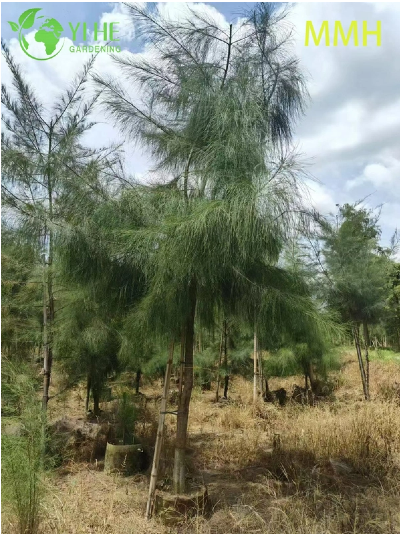
Wind can affect comfort, soil moisture, and the performance of surrounding plants. In exposed spaces, Casuarina equisetifolia is often planted because it helps reduce wind impact and creates a more stable outdoor environment.
This is especially useful in coastal roads, beachfront properties, and broad open sites where strong airflow is part of daily conditions. A tree that can stand up to wind while also helping manage it adds clear value to a landscape plan.
Another reason this tree is frequently used in coastal planting is its role in supporting ground stability. Sandy areas are often vulnerable to erosion and movement, and planting that helps hold the site together has practical importance.
Casuarina equisetifolia is linked with this kind of use because it is suitable for projects where sand control and site support matter. For landscapes near dunes, coastal edges, and exposed ground, that function can be just as important as visual impact.
Beyond its environmental role, this tree is also useful in shaping outdoor space. Its height and vertical form bring structure to large landscapes, while the canopy can provide practical shade along roads, paths, and open seating areas.
In parks, resorts, and waterfront landscapes, this helps create spaces that feel more complete. The tree adds order, scale, and usability without making the site look overly dense or heavy.
Feature | What It Means in Practice | Best Project Type |
Fine, airy texture | Adds movement without visual heaviness | Resorts, parks, waterfront walks |
Upright growth | Creates strong vertical structure | Roadsides, greenbelts, boundary planting |
Salt and wind tolerance | Handles exposed coastal conditions well | Beachside and shoreline projects |
Adaptation to sandy soil | Better site fit in poor ground | Coastal planting, dune-edge landscapes |
Windbreak function | Helps improve comfort and protection | Shelterbelts, open public sites |
Practical shade | Adds usable outdoor comfort | Parks, rest areas, resort grounds |
For first-time buyers, the most important step is to connect the tree with its intended role. Casuarina equisetifolia may be planted for screening, wind protection, ground support, shade, or overall landscape structure. That purpose should shape the planting plan from the beginning.
Tree form also matters. In project planting, customers usually need healthy growth, consistent quality, and forms that suit the design intention. This is particularly important in roadsides, public works, resort developments, and larger coastal projects where visual continuity makes the result stronger.
Maintenance expectations should stay practical. Even a hardy coastal tree benefits from proper planting and establishment care. Good matching does not remove all maintenance, but it makes long-term performance much more reliable.
A tree may look attractive in a product image, but true value appears after planting. Casuarina equisetifolia works best when the site and the planting purpose fit its strengths. That is why it is such a strong choice for sunny, windy, sandy, and exposed projects.
It is also why customers benefit from defining their needs clearly before ordering. Is the project aiming to create a windbreak, support a sandy site, build shade in a broad open area, or add structure to a coastal landscape? The clearer the purpose, the easier it becomes to see whether this tree is the right fit.
For international customers, providing site details, preferred sizes, and planting goals can help create a more accurate product match. That is especially valuable for projects where performance matters as much as appearance.
Casuarina equisetifolia is not simply a tree with an unusual appearance. It is a practical landscape choice for sites that are sunny, exposed, sandy, and shaped by coastal conditions. For planners, contractors, and property owners looking for a tree that combines resilience with visual character, Ornamental Coastal Casuarina equisetifolia Tree offers a clear advantage. YIHE supports customers with project-based plant solutions for outdoor landscapes of different scales. Contact us to discuss your site conditions, planting plans, and size requirements.
Yes. Casuarina equisetifolia is widely used in coastal landscaping because it handles sun, wind, salt exposure, and sandy soil better than many standard ornamental trees.
It resembles a pine because of its fine, needle-like appearance, but the texture actually comes from slender branchlets rather than true pine needles.
It is commonly planted in beachfront developments, coastal roadsides, resort landscapes, parks, greenbelts, and other exposed outdoor spaces.
Buyers should confirm the planting purpose, site conditions, preferred plant size, and project scale. This helps ensure Casuarina equisetifolia matches the landscape application more accurately.


