
- All
- Product Name
- Product Keyword
- Product Model
- Product Summary
- Product Description
- Multi Field Search
Views: 0 Author: Site Editor Publish Time: 2026-11-23 Origin: Site


Have you ever paused to admire the stunning "Lilac of the South" in full bloom? These vibrant trees offer unmatched summer beauty. They easily transform ordinary streets and yards into spectacular floral displays. Yet, picking the right size and shape causes major headaches for many homeowners and urban planners. Making the wrong choice often leads to overgrown canopies and blocked sightlines. It also creates an endless, exhausting cycle of pruning.
Are you specifying trees for a municipal avenue or designing a residential patio? Understanding the unique growth habits of these resilient plants is your first step to landscaping success. In this field guide, you will learn exactly which structural form works best for your specific project. This ensures vibrant color and structural elegance for decades to come.
Street Planting Requires Clearance: Single-trunk standard forms are the most practical choice for sidewalks and medians. They allow sufficient pedestrian and vehicular clearance.
Gardens Thrive on Multi-Trunk Forms: Multi-trunk structures offer year-round sculptural interest. They serve as highly effective garden focal points even during the dormant winter months.
Dwarf Varieties are Versatile: Compact cultivars serve as excellent low-maintenance solutions. They work perfectly for small residential spaces, container gardening, and flowering ground cover applications.
Superior Landscape Value: These resilient plants offer an unmatched combination of exceptionally long bloom times and high drought tolerance. They also demand relatively low maintenance.
Buy Smart for Large Projects: Sourcing your plants in bulk through wholesale channels ensures visual uniformity. It guarantees genetic consistency and significant cost savings for large-scale designs.
Recent shifts in urban forestry highlight a growing demand for climate-resilient street trees. City planners and commercial developers are actively transitioning away from water-intensive species. The focus is now on mitigating urban heat islands with drought-tolerant staples. Modern landscape architecture prioritizes vegetation that can withstand high radiant heat from asphalt while maintaining high aesthetic value.
Furthermore, the shrinking size of modern residential lots has skyrocketed the demand for compact cultivars. Versatile plant forms are now more critical to the nursery industry than ever before. Property owners want maximum visual impact without the aggressive root systems that threaten underground utilities. This industry-wide pivot makes selecting the precise tree form a functional necessity rather than just a design preference.
To make informed landscaping decisions, you must first understand the basic structural forms. The species is biologically predisposed to grow as a multi-stemmed large shrub. However, horticulturists have developed distinct structural forms through selective breeding and precise nursery cultivation. These forms solve highly specific landscape design challenges.
A single-trunk specimen is often referred to as a standard or tree-form. Growers cultivate this by selecting the strongest central leader while the plant is still a young sapling. Nursery professionals meticulously prune away all competing lateral branches and basal shoots over several growing seasons. This rigorous training forces the plant energy into a single robust trunk. It mimics the structure of traditional shade trees, elevates the canopy, and provides clear walkable space beneath the branches.
In contrast, the multi-trunk form embraces a wilder natural growth habit. Cultivators typically shape this to feature three to five main trunks. This form develops a distinctive vase-like architectural shape. The trunks gracefully diverge from the base to create a wide spreading canopy. Landscape architects particularly value this form for its structural aesthetics. The multiple intertwining stems provide a wider canvas to display the signature peeling bark.
Not all planting scenarios require a towering canopy. Growers cultivate shrub forms to remain bushy. These feature dense branching that begins very close to the ground line. Landscapers frequently utilize them for informal hedges or property screening.
Taking compactness a step further, miniature and dwarf categories include cultivars specifically bred to stay under three to five feet in mature height. These compact forms maintain the prolific blooming characteristics of their larger counterparts. However, they feature much shorter internodes and a naturally rounded dense growth habit. Consequently, they eliminate the need for aggressive size-control pruning. This makes them a favorite for low-maintenance commercial landscapes.
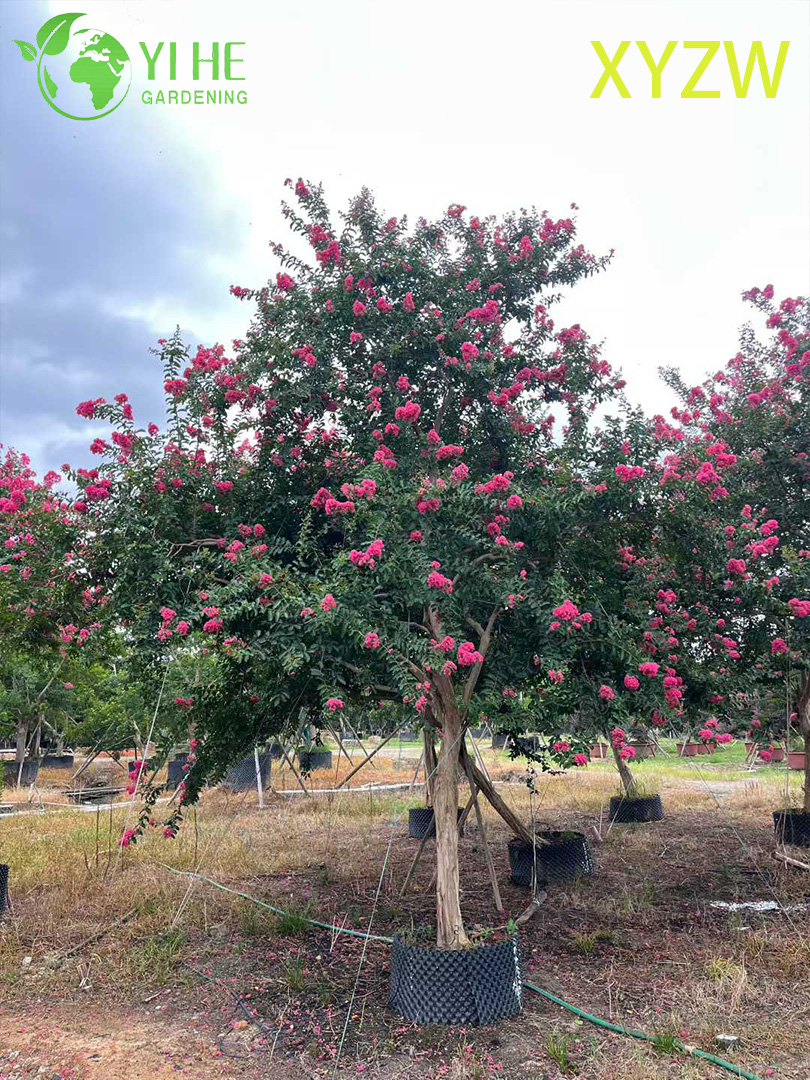
Urban planners, homeowner associations, and municipal landscapers face strict spatial constraints. They must select vegetation carefully for street sides, curbs, and median strips. In these demanding environments, the structural form of the tree is just as critical as its aesthetic appeal.
Vertical clearance is a non-negotiable requirement for street planting. Pedestrians require unobstructed walkways. Parked vehicles need overhead clearance to avoid paint damage. Traffic safety relies heavily on clear lines of sight at intersections. Single-trunk forms are the definitive choice for these civic applications. These standards prevent the canopy from encroaching on public rights-of-way by elevating the lowest branches to a height of six to eight feet.
Their root systems are generally fibrous and non-destructive compared to aggressive species like willows or maples. The roots of a single-trunk specimen are highly unlikely to heave concrete sidewalks or disrupt underground utility lines when provided with an adequate planting strip. A three to four-foot wide strip is usually sufficient.
Successful street planting requires selecting cultivars with an upright columnar growth habit. You should avoid wide-spreading umbrella-like canopies. Columnar varieties keep the foliage and blooms contained within a narrower footprint. This drastically reduces the risk of branches interfering with passing commercial vehicles or streetlights.
Urban streetscapes are notoriously harsh environments. They feature high levels of exhaust pollution and intense radiant heat reflected from asphalt. Fortunately, urban foresters highly regard these trees for their exceptional tolerance to these stressors. Once established, they thrive in the microclimates created by paved surfaces. They actually utilize the extra heat to fuel their prolific summer bloom cycles.
Street plantings demand strict uniformity and clearance. Residential and commercial gardens, however, offer creative freedom. You can utilize plants for their artistic and architectural merits. In these curated settings, the form dictates its function within the broader landscape design.
A focal point is an anchoring element that immediately draws the eye in garden design. Multi-trunk forms excel in this role. Their vase-like structure provides a sense of scale and permanence in front yards. They also work perfectly as the centerpiece of a large perennial bed. Imagine a mature specimen with its sweeping branches casting dappled shade over a quiet garden bench.
The true value of the multi-trunk form reveals itself in winter. They drop their leaves in late autumn as deciduous trees. Many trees look barren and lifeless in winter. The multi-trunk form, however, showcases its smooth mottled cinnamon-colored peeling bark. The intertwining trunks create a striking winter silhouette against the sky or a nearby building. Strategic uplighting placed at the base can dramatically highlight this architectural feature at night.
Large shrub-form varieties are highly effective when utilized as borders or privacy screens. Landscapers can cultivate a dense flowering hedge by planting these bushy forms in a linear row with appropriate spacing. This obscures unsightly views or provides seclusion for backyard patios.
Traditional evergreen hedges offer a static green wall. A flowering screen provides dynamic seasonal changes instead. You get bright green spring foliage, vibrant summer blossoms, and rich autumn colors. For properties in cooler hardiness zones, pairing these with cold-tolerant ornamental landscape trees creates a resilient year-round boundary. This setup withstands harsh winter winds while delivering spectacular summer color.
High-density housing and small-space gardening are becoming increasingly prevalent. Landscape designers are turning to compact plant varieties to deliver maximum impact in minimal square footage. The dwarf category has emerged as a premier engineering solution for these constrained environments.
Not every landscape project involves open ground. Container gardening is often the only viable option for patios, wooden decks, apartment balconies, and paved courtyards. Selecting an export-grade dwarf crape myrtle tree provides the visual impact of a flowering canopy without the massive root system. Standard trees would quickly outgrow a pot.
These compact varieties thrive in large well-draining planters. They bring vibrant eye-level color to outdoor living spaces. It is vital to use a high-quality potting mix when planting in containers. This ensures adequate drainage. You must monitor moisture levels closely because potted plants dry out significantly faster than those planted in the ground.
Miniature forms are increasingly being utilized in innovative ways beyond containers. Landscapers mass-plant them to serve as a flowering ground cover or a low border along walkways. These varieties naturally max out at just three to five feet in height. Therefore, they require virtually no structural pruning.
They create a sweeping carpet of ruffled summer blossoms when planted en masse on a slight slope. This suppresses weeds and controls minor soil erosion. This application is particularly useful for commercial landscapes where low-maintenance and high-visibility planting beds are required.
Designers often weigh their options against other popular species during the planning phase. Flowering Cherries, Dogwoods, or Saucer Magnolias are common alternatives. Those species certainly have their merits. However, specific horticultural advantages make this species a superior choice for many regions.
The most significant advantage is the extraordinary bloom duration. Most spring-flowering trees provide a spectacular but fleeting display. It usually lasts only two to three weeks. They serve merely as green shade trees for the remainder of the year once their petals fall.
These trees are relentless summer bloomers. They begin flowering in early to mid-summer. They can continue to produce vibrant panicles of flowers for 100 days or more. They push right through the hottest and most challenging parts of the season. This extended bloom period ensures that the landscape remains dynamic long after other species have finished their reproductive cycles.
Water conservation is a critical factor in modern landscaping. This species exhibits remarkable drought tolerance once properly established in the landscape. This typically occurs after its first two growing seasons. Their deep resilient root systems allow them to thrive in dry conditions and poor soils. Such environments would easily stress or kill more delicate ornamentals.
Modern breeding programs have developed numerous cultivars with high resistance to common afflictions. Powdery mildew and Cercospora leaf spot are no longer major threats for premium varieties. Property owners can drastically reduce the need for chemical fungicides by selecting these disease-resistant varieties. This makes them a highly sustainable choice for green building projects.
Even the most robust tree requires proper installation and care to reach its full potential. Understanding fundamental horticultural requirements ensures your plants remain healthy and structurally sound. It guarantees they will be prolific bloomers for decades.
These trees are obligate sun-lovers. They must be planted in a location that receives full sun for maximum flower production. We define full sun as a minimum of six to eight hours of direct unfiltered sunlight per day. Planting them in partial shade will inevitably result in sparse blooming and leggy growth. It also causes a higher susceptibility to fungal diseases due to lingering moisture on the leaves.
Soil drainage is equally critical in the field. They tolerate a wide range of soil types including heavy clay and sand. However, they cannot survive in waterlogged conditions. It is advisable to plant the root ball slightly above the surrounding grade if planting in poorly draining clay.
Spacing should always be dictated by the mature width of the tree rather than its size in the nursery pot. Overcrowding restricts airflow through the canopy. Poor airflow is a primary catalyst for mildew.
Tree Form Specification | Average Mature Width | Recommended On-Center Spacing | Ideal Landscape Application |
|---|---|---|---|
Standard Single-Trunk | 15 - 25 feet | 12 - 15 feet apart | Streetscapes, urban sidewalks, commercial parking islands |
Multi-Trunk Shrub/Tree | 10 - 15 feet | 8 - 10 feet apart | Privacy screens, property borders, architectural focal points |
Dwarf / Miniature Varieties | 3 - 5 feet | 3 - 4 feet apart | Container gardens, low borders, mass ground cover |
Proper pruning is perhaps the most misunderstood aspect of maintenance. A widespread but highly detrimental practice involves severely topping the tree. Landscapers sometimes indiscriminately saw thick trunks down to bare stumps every winter.
This aggressive method forces rapid spindly vegetative growth. These weak shoots produce large flower clusters. However, the stems are structurally incapable of supporting the weight. This causes branches to snap during summer rainstorms. Topping destroys the natural elegant vase-like architecture and leaves large wounds susceptible to rot.
Correct structural pruning involves thinning rather than topping. Using clean bypass pruners, you should limit maintenance to removing crossing or rubbing branches. Clear out dead wood and snip away basal suckers at the ground level. This opens the center of the canopy. It allows sunlight to penetrate and air to circulate freely.
The procurement phase is just as important as the design phase for landscape architects and city planners. Sourcing high-quality plant material efficiently can make or break a project budget and timeline.
Sourcing crape myrtle trees wholesale offers profound economic and logistical advantages when planning a neighborhood streetscape. Commercial nurseries operate on volume. This allows them to offer significant price reductions compared to retail garden centers. Wholesale suppliers typically provide standard 2-inch to 4-inch trunk calipers with uniform branching structures.
Wholesale procurement guarantees landscape uniformity beyond strict financial savings. This is a vital component of professional design. It is visually imperative that all trees share identical bloom colors when lining a boulevard. They must possess similar trunk caliper sizes and exhibit matching canopy structures. Sourcing a large batch from a single grower ensures that the trees have been cultivated under the exact same conditions. This results in a cohesive synchronized appearance immediately upon installation.
Assessing the health of the plant material before taking delivery is essential. Buyers should look for a well-developed balanced canopy. The vibrant foliage must be free from white powdery mildew spots. The main trunk should be straight and free of deep mechanical scars from transport.
Crucially, you must inspect the root system. Trees left in nursery containers for too long can become root-bound. Thick roots circle the inside of the pot in this condition. These circling roots can eventually girdle and strangle the tree years after planting. A healthy root system should be fibrous and firm. This indicates a vigorous plant ready to establish itself rapidly in your native soil.
Choosing the right form is the secret to unlocking the full potential of these magnificent plants. Single-trunk trees work best for busy streets and sidewalks where vertical clearance is mandatory. Multi-trunk forms create stunning architectural garden focal points that provide year-round interest. Dwarf varieties fit perfectly in tight spaces. They offer vibrant color without the overwhelming size or maintenance.
These trees are excellent long-term landscape investments. They reward you with months of beautiful blooms, striking winter bark, and remarkable drought tolerance. Evaluate your specific planting space carefully today. Ready to specify the perfect trees for your next commercial or residential project? Visit Yihe Garden to explore our premium wholesale selections and bring your landscaping vision vividly to life.
No, the roots are relatively shallow, fibrous, and non-invasive. They expand horizontally to seek moisture but lack the mass and force to heave heavy concrete. They are excellent safe choices for street and sidewalk planting applications when planted with adequate soil volume and a standard clearance space of three to four feet from the edge of the concrete.
Yes, you can select the strongest straightest central stem to serve as the main trunk while the tree is still very young and pliable. You must prune away all competing basal stems. This requires consistent monitoring and the removal of new suckers over several growing seasons. From a practical standpoint, it is significantly more efficient to purchase a single-trunk standard form directly from a nursery. The grower has already invested years of structural training into the plant.
Breeders specifically design dwarf varieties for compact growth habits. They generally grow at a moderate rate of one to two feet per year under optimal conditions. They stop growing once they reach their genetic mature height, which is typically capped between three and five feet. They will never surge into the massive 20-foot canopies associated with standard varieties.
Yes, they are deciduous. They will drop all their foliage in the late autumn. This physiological process is actually a distinct landscaping advantage. Shedding their leaves reveals the stunning smooth mottled peeling bark. This exfoliating bark provides exceptional architectural and textural interest during the barren winter months.
The decision depends entirely on the scale of your project. Purchasing a retail tree from a local garden center is perfectly fine if you are planting a single focal point in a residential front yard. Buying wholesale is the superior choice if you are lining a long driveway or executing a commercial landscape design. Wholesale purchasing ensures uniform growth rates, perfectly matching bloom colors, and identical structural training.
The best time to plant is during late fall or early spring while the tree is dormant. Planting during these cooler months allows the fibrous root system to establish itself in the soil before the intense heat of summer arrives. Container-grown trees can technically be planted year-round, but summer plantings require rigorous daily watering to prevent severe transplant shock.
You should plant standard single-trunk or large multi-trunk varieties at least 10 to 15 feet away from a house foundation. This spacing prevents the mature canopy from rubbing against the roofline or gutters. Dwarf varieties can be planted much closer, typically three to four feet from the foundation, making them perfect for low foundation planting beds.


