
- All
- Product Name
- Product Keyword
- Product Model
- Product Summary
- Product Description
- Multi Field Search
Views: 0 Author: Site Editor Publish Time: 2026-08-12 Origin: Site


The highest mortality rate for a newly purchased Ficus Lyrata occurs within the first 30 days post-delivery. Acute light starvation and severe environmental shock primarily drive this rapid decline. Garden centers frequently market the fiddle leaf fig tree as an easy houseplant, creating a massive expectation gap when the plant rapidly deteriorates indoors. In reality, it is a highly sensitive canopy species that demands precise environmental matching to sustain its massive foliage.
Transitioning a plant from optimized greenhouse conditions to standard indoor environments often results in rapid defoliation. Buyers must accurately assess their spatial light availability before finalizing placement to protect their investment. Guessing light levels based on human eye perception consistently leads to plant failure. This guide provides a technical framework for measuring light intensity, executing a phased post-delivery acclimation strategy, and evaluating supplemental lighting requirements to ensure long-term structural stability.
Establishing the difference between surviving and thriving requires understanding plant metabolism. Surviving means the plant barely generates enough energy to prevent total leaf drop. Thriving means it actively generates new growth, expands its root system, and maintains rigid structural integrity. Success requires matching the plant's metabolic light demands with measurable environmental inputs. When you bring a large specimen indoors, you are essentially placing a high-performance engine into a low-fuel environment. The leaves act as solar panels. If the panels do not receive enough photons, the engine stalls. We see this constantly in field installations. Clients place massive trees in dark corners and wonder why the lower leaves turn yellow and detach within weeks. The plant cannibalizes itself. It sheds older, less efficient leaves to redirect limited energy to the top growth point.
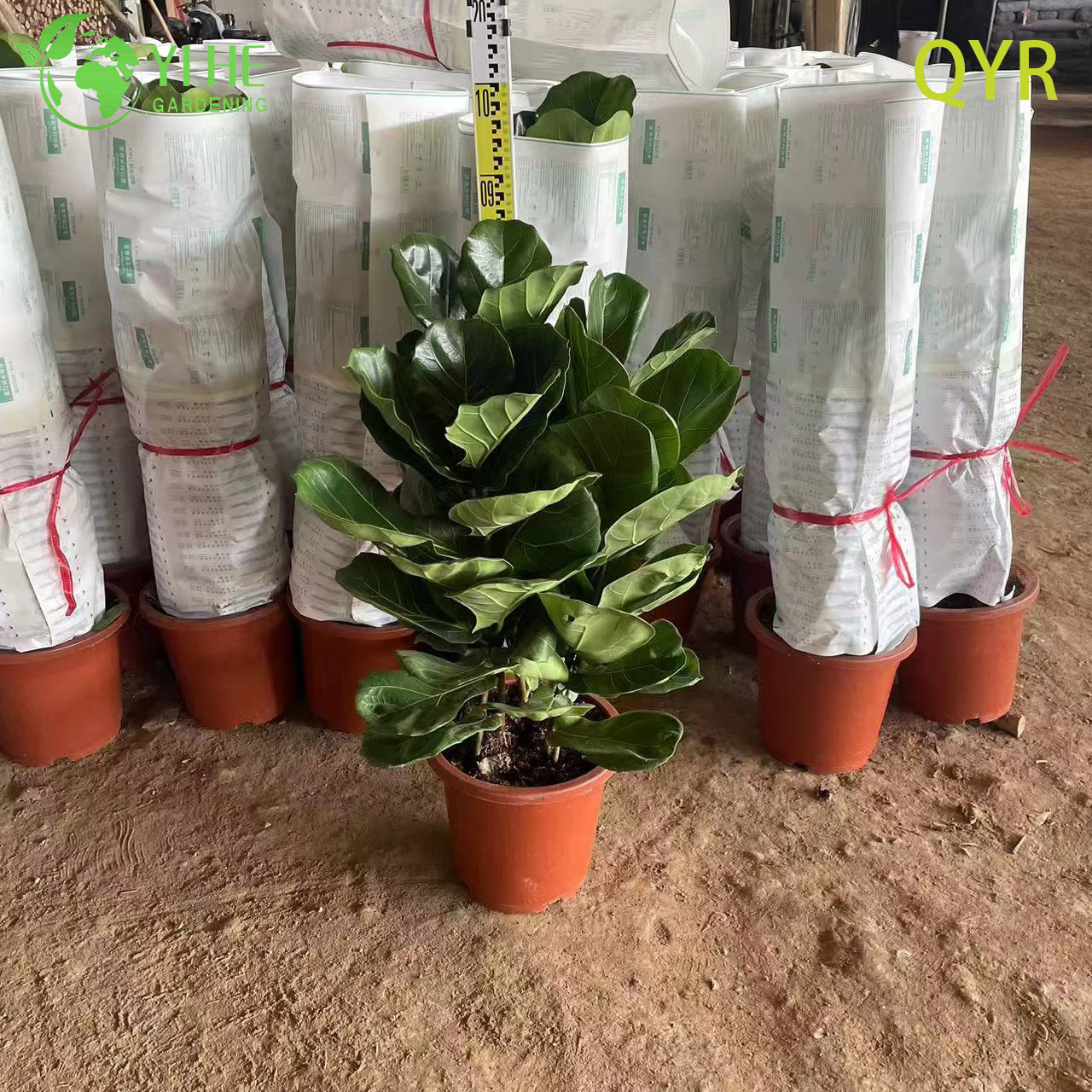
Plants originating from ficus lyrata wholesale environments grow under optimal parameters. Commercial greenhouses provide a massive Daily Light Integral (DLI). Light hits the canopy from directly overhead. Specialized glass or polycarbonate roofing diffuses this light perfectly. Commercial growers maintain humidity levels between 70% and 85%. They manage Vapor Pressure Deficit (VPD) to ensure stomata remain open for maximum CO2 absorption. Temperatures stay consistently warm, promoting rapid cellular division and broad leaf expansion. The root systems develop in highly porous, fast-draining media like coarse pine bark and perlite, designed for daily fertigation cycles.
Standard residential or commercial interiors present a hostile contrast. Light enters laterally through vertical windows, drastically reducing the usable surface area of the leaves. Modern architectural glass often features UV and infrared filtration, stripping out wavelengths necessary for robust photosynthesis. Structural shading from roof overhangs, neighboring buildings, and nearby trees further diminishes light volume. Finally, dry HVAC drafts strip moisture from the foliage. The plant closes its stomata to conserve water, which halts gas exchange and stops photosynthesis entirely. We routinely measure a 90% drop in usable light energy just moving a plant from a greenhouse floor to a standard living room.
Horticultural success requires moving beyond subjective terms like "bright light." Human eyes automatically dilate in dark rooms, making dim spaces appear much brighter than they actually are. You must define light requirements using objective metrics like Foot-candles (FC) or Lux. One foot-candle equals the amount of light cast by one candle at a one-foot distance. For optimal health, target a baseline of 400 to 800 FC just to maintain existing foliage. Pushing new growth requires 800 to 1000+ FC.
Understanding Photosynthetically Active Radiation (PAR) is equally necessary. PAR measures the specific light wavelengths (400 to 700 nanometers) that drive photosynthesis. Standard room lighting emits negligible PAR. Recessed ceiling bulbs or decorative lamps do nothing for plant metabolism. This explains why standard interior lighting fails to support indoor ornamental plants. They require concentrated, spectrum-specific energy.
Filtered light involves achieving high-intensity illumination without causing thermal damage to the leaf tissue. In nature, upper canopy diffusion provides this protection. Indoors, you replicate this by utilizing sheer curtains over South-facing windows. This scatters the intense midday rays. You get high PAR volume while preventing localized heat buildup on the leaf surface.
Moving a plant directly from a dark delivery truck to its final destination triggers severe stress responses. The plant spends days in transit, experiencing temperature fluctuations, physical vibrations, and total darkness. Immediate exposure to intense light causes rapid cellular breakdown. Conversely, immediate placement in a dark corner signals the plant to shed its lower foliage to conserve energy. Botanists call this rapid lower-leaf abscission. You must manage this transition actively.
Mitigating transit shock requires a disciplined, phased approach. The 21-day stepping protocol allows the plant to adjust its internal chemistry and structural orientation to the new environment. We use this exact timeline for commercial installations to guarantee zero leaf drop.
Assessing architectural light sources determines viability without requiring supplemental hardware. The objective is to utilize the brightest room in the home while carefully managing direct ray exposure. Proper placement prevents both starvation and thermal damage. You need to map the room's light profile before moving the heavy planter into position.
Window orientation dictates both the intensity and duration of natural light entering a space. Evaluating these directions ensures you match the plant's biological needs with the room's physical capabilities.
| Window Orientation | Light Quality | Thermal Risk | Placement Strategy |
|---|---|---|---|
| East-Facing | Morning direct sun, afternoon ambient light. | Low | Optimal. Place within 2-4 feet of the glass. No sheer curtains required. |
| South-Facing | Highest volume of sustained daily light. | High (Midday) | Place 3-5 feet back, or use sheer diffusion to prevent foliar bleaching. |
| West-Facing | Intense, hot late-afternoon sun. | Very High | Requires careful distance management (4-6 feet) and temperature monitoring. |
| North-Facing | Weak, indirect ambient light only. | None | Insufficient for long-term maintenance. Requires supplemental LED support. |
Light intensity does not degrade linearly. It drops exponentially as distance from the window increases. This phenomenon is governed by the inverse-square law. If you move a plant twice as far from a window, it receives only one-quarter of the light energy. A spot that looks bright to the human eye at ten feet away is functionally dark to a plant. We see clients place trees eight feet from a window and expect vigorous growth. The physics of light simply do not support this.
Consider a practical field measurement. Right at the glass of a South-facing window, a light meter might read 2000 FC. Move the meter just two feet back, and the reading drops to 500 FC. Move it four feet back, and you might record a mere 125 FC. This rapid degradation explains why a plant placed in the center of a room starves, even if the room feels bright to you. You must measure the light exactly where the foliage will sit.
Measure this drop-off accurately to avoid placement errors. Download a reliable light meter application on a smartphone or purchase a dedicated digital lux meter. Take measurements at the canopy level, not at the floor. The upper leaves are the primary solar panels. If the upper canopy registers below 400 FC during peak daylight hours, the location is unsuitable without intervention. Take readings at 9 AM, 12 PM, and 3 PM to calculate an accurate daily average.
Architectural limitations often prevent optimal natural placement. When baseline light metrics cannot be met naturally, you must evaluate hardware interventions. Determining when natural light is insufficient prevents irreversible decline. Do not wait for the plant to lose half its leaves before adding a grow light.
Plants communicate light starvation through specific structural changes. Internodal elongation is the most common early indicator. This occurs when the stem stretches excessively between new leaves, resulting in a sparse, leggy appearance. The plant is desperately reaching for a stronger light source. A complete lack of new growth during active spring and summer seasons also indicates starvation. Finally, the progressive yellowing and dropping of lower leaves confirms the plant is cannibalizing older tissue to keep the apical meristem alive.
Selecting the correct supplemental lighting requires evaluating specific technical criteria. Avoid cheap, low-output hardware that provides merely decorative illumination. USB-powered clip lights do not generate enough photons to sustain a large floor plant.
The cost of misdiagnosis often results in fatal secondary issues. The most common consequence of unrecognized light starvation is severe overwatering. When light levels drop, metabolic water consumption halts. The plant stops pulling moisture from the soil. What was previously an evenly moist substrate quickly becomes a stagnant, anaerobic environment. This serves as a primary catalyst for fatal root rot. You must read the leaves and probe the soil to adjust your care routine.
Light starvation manifests through a predictable sequence of symptoms. Growth becomes entirely stagnant. When new leaves do emerge, they are significantly smaller and paler than older foliage. The plant lacks the energy to produce dense chlorophyll. As starvation progresses, the oldest, lowest leaves turn solid yellow and detach easily. The plant actively sheds inefficient solar panels to reduce its metabolic load.
You can confirm light starvation by inspecting the soil. Use a wooden moisture meter or a soil probe. If the top three inches of soil remain wet for more than 14 days, the plant is not photosynthesizing. It is not drinking. The roots sit in stagnant water, suffocating from a lack of oxygen. Healthy roots require a cycle of wet and dry periods. Low light eliminates the dry period, leading directly to root rot.
While rare indoors, over-exposure occurs when plants sit directly against hot, unshaded South or West windows. Symptoms include crispy, bleached, or red/brown scorched patches on the uppermost leaves. The damage is highly localized to the tissue directly facing the sun. The edges of the leaves may curl inward to reduce surface area exposure. The soil will dry out completely within two or three days.
You must act immediately to mitigate this. Relocate the plant 12 to 24 inches further away from the glass. Alternatively, install physical light filtration. UV window films or sheer white curtains effectively scatter the intense radiation. This preserves high PAR levels while eliminating the thermal threat.
A: Ficus lyrata requires 6 to 8 hours of bright, indirect sunlight daily to maintain its foliage, and up to 10 hours for optimal new growth. If using artificial grow lights, run them for 12 to 14 hours to compensate for lower overall intensity.
A: No. Without windows, a fiddle leaf fig will rapidly deteriorate unless supported by dedicated, high-intensity full-spectrum LED grow lights running for 12-14 hours a day. Natural light or specialized horticultural lighting is mandatory for survival.
A: Post-delivery leaf drop is typically caused by environmental shock, specifically a sudden reduction in light intensity compared to the wholesale greenhouse, or drafts during transit. Implement a gradual 21-day acclimation protocol to stabilize the root system and prevent further defoliation.
A: For optimal health, place the plant within 3 to 5 feet of a large South or East-facing window, ensuring the canopy receives a wide angle of the sky without resting directly against hot glass. This prevents thermal scorch while maximizing light absorption.
A: Morning sun (East-facing) is highly beneficial as it provides intense light with low heat. Afternoon sun (West-facing) can be too hot and may require sheer curtains to prevent leaf scorch and excessive dehydration.
A: Signs of excessive light include bleached, faded foliage, or distinct crispy brown scorch marks on the top leaves directly exposed to the sun's rays. The leaves may also curl inward to protect themselves from intense radiation.
A: Yes. Light dictates the plant's metabolic rate. A fiddle leaf fig in bright, optimal light will typically need watering every 7-10 days, whereas a plant in lower light will consume water much slower, increasing the risk of root rot if watered on the same schedule.


